A practical look at the three failure points that decide whether a 6-metre lightbox looks premium — or looks repaired.
A 6.6-metre lightbox goes up in a shopping mall. From three metres away it looks perfect. At night, when the backlight comes on, a faint vertical band appears across the middle of the graphic — right where two panels meet.
The brand owner rejects it. The print shop reprints it. The deadline slips by four days, and everyone absorbs the cost: media, ink, labour, machine time, and a little bit of trust.
Ask any large-format production manager in Europe or North America what hurts most, and the answer is rarely “our printer is too slow.” It is almost always rework — the job that has to be run twice because the first one was not good enough to ship.
Rework has three root causes. All three are mechanical. All three are decided the day you choose the machine.
FAILURE POINT ONE: SEAMS THAT ONLY APPEAR UNDER BACKLIGHT
Seams come from three places, and buyers usually blame the wrong one.
Panel width. If the job is wider than the machine, it is stitched — and every stitch is a place where colour density and dot placement have to match perfectly across two separate passes. On a lightbox, that mismatch is amplified by the backlight.
Head stitching inside the machine. On a multi-head printer, the image is built from overlapping head swaths. If the array is not calibrated precisely — and re-calibrated as heads age — you get banding that is invisible on white media and obvious on a lightbox at night.
Web drift. A 6-metre-wide roll of banner material is heavy. If tension is not held consistently from unwind to take-up, the media creeps a fraction of a millimetre per metre. Over a 30-metre run, that is a visible skew, a wrinkled edge, and a job that fails inspection.
None of these are operator errors. They are design decisions.
FAILURE POINT TWO: WHITE INK AND VARNISH ARE WHERE CHEAP MACHINES SHOW THEMSELVES
White ink is the highest-value part of a backlit or window graphic — and the fastest way to expose a weak platform.
White pigment settles. If the ink system does not recirculate continuously, opacity drifts across a long run: dense at the start of the roll, thin at the end. Under backlight, that reads as blotches and hot spots.
Varnish has the same problem in a different form. An uneven gloss layer catches light at different angles and produces visible banding on the finished sign — a defect that only shows up after lamination, when the material is already wasted.
Both issues are solved in the ink delivery system, not in the RIP. Ask how the machine circulates white ink, and how it maintains viscosity over a full shift.
FAILURE POINT THREE: THROUGHPUT THAT DEPENDS ON THE OPERATOR
A machine that needs a skilled hand to keep it aligned is a machine that produces differently on Monday morning and Friday afternoon.
The measurable symptoms are predictable:
rewind that drifts and needs manual correction
media that wrinkles at the edges at higher speeds
colour that shifts between the first and last metre of a roll
a reprint rate that nobody tracks, because it is spread across shifts
Production managers rarely put a number on this. It is usually between 3% and 8% of media consumption — which, over a year, is a machine.
WHAT “ENGINEERED FOR ONE PASS” ACTUALLY MEANS
A wide-format platform built for advertising production, rather than adapted from a graphics printer, is designed around three commitments.
One-piece output at the working width. A 6.6-metre platform prints the widest common lightbox and banner jobs in a single pass, so there is no stitch to hide and no matching to chase.
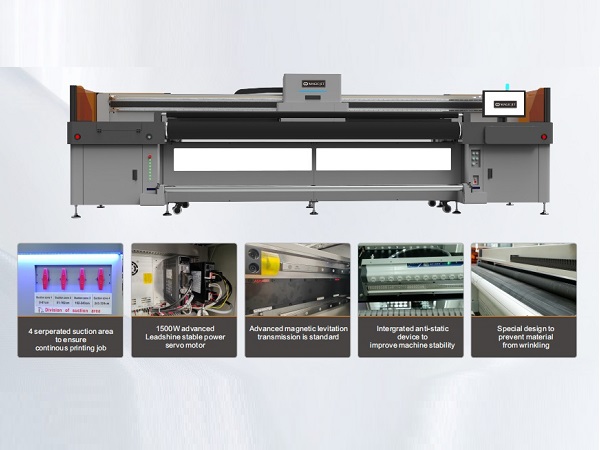
A modular head array that scales with the job. Industrial piezo heads — Ricoh and Konica types are the industry standard — arranged in a linear array that can be configured from 8 heads upward to 40. Low-volume shops buy the configuration they need today; production houses add heads as order volume grows, instead of replacing the machine.
Web handling treated as a first-class system. Tension-controlled unwind and take-up, edge guidance and a stable media path are what keep a 30-metre run as flat at the end as it was at the start. This is unglamorous engineering, and it is the difference between a machine that runs unattended and one that needs a person standing next to it.
A BUYER’S CHECKLIST BEFORE YOU SIGN
Eight questions worth asking any supplier — including us:
Can the machine output my widest recurring job in one piece?
How are the heads calibrated across the array, and how often does it need to be redone?
Is the head count expandable later, and at what cost per head?
What kind of tension control does the media feed use?
Does the white ink system recirculate continuously?
What is the spare-parts lead time to my country, and is remote diagnostics included?
Will you send a sample print of my file, on my media, before I order?
Can I see the factory — in person, or on a live video walkthrough?
Any supplier who hesitates on questions 7 and 8 is telling you something.
WHERE THE OMAJIC MJ-6600 FITS
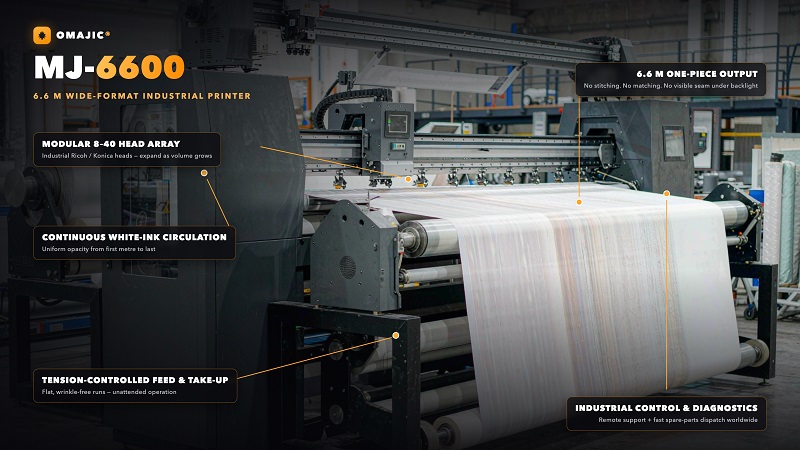
The MJ-6600 is built for exactly the production profile described above: advertising and lightbox work where a seam is not acceptable and white ink is part of the job.
It prints at 6.6 metres in a single pass, uses a modular Ricoh/Konica industrial head array configurable from 8 to 40 heads, and pairs a tension-controlled feed and take-up system with continuous white-ink circulation — the three failure points, addressed at the design stage rather than in the operator’s manual.
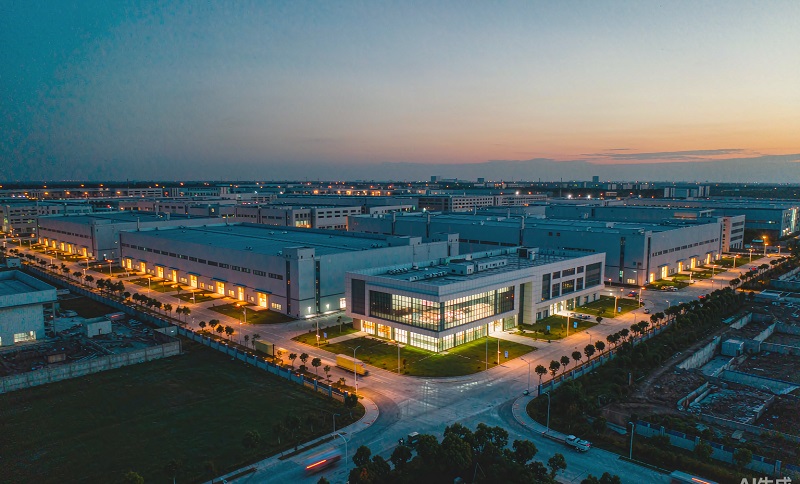
It is manufactured in our own plant, assembled and run-in tested before shipment, and supported with spare parts and remote diagnostics for overseas customers. OEM and ODM configurations are available for distributors who need their own specification.
If you are evaluating a wide-format machine this quarter, send us a file you would actually print — a backlit graphic with a white layer and a gloss finish is the honest test. We will run it and send you the output, so you can judge the seam, the white density and the gloss yourself.
Because the only specification that matters is the one your customer accepts at night, under backlight, from three metres away.
ABOUT
OMAJIC designs and manufactures large-format digital printing systems for the advertising, signage and display industry. Our machines are built in-house, tested before shipment, and supported worldwide.
Specifications vary by configuration and market. Contact us for the current configuration sheet for your region.